


22:59:22 alexandria, va
Thursday, 6.05.25
■
Virtual Executive Leadership (VEL) in a Global Market
Leading Distributed Teams with Trust,
Continuity and Cultural Intelligence
Praise for Virtual Executive Leadership in a Global Market
-
As the unfolding of the Digital Age takes place before our eyes, modern executives will need to develop new skills and competencies in order to navigate this new terrain. In Virtual Executive Leadership in a Global Market, Dr. Bill Bersing provides an invaluable service in bringing virtual executive leadership benefits, tools, and skillsets to the forefront. In an era where trust will depend not on personal contact but the ability to establish trust across different countries and cultures, people who master these skills will have extraordinary advantages in terms of productivity, execution and relationship building. If you are in such a situation, pick up this book. You will be glad you did.
Stephen Jordan, CEO, Institute for Sustainable Development
-
As a disaster recovery and resilience professional who has managed complex projects worldwide, I am pleased to endorse Virtual Executive Leadership in a Global Market heartily. It captures the spirit of adaptable, human-focused innovation. It provides clear, usable examples, stressing that 21st-century leaders must build trust, maintain continuity, and cultivate cultural intelligence to manage distributed teams across virtual and cultural divides.
Grounded in research and principles from engineering and finance, it offers a framework based on transparency, knowledge portability, and tools to create resilient global organizations amid potential disorder. It urges executives to integrate Artificial Intelligence, but only in ways that safeguard human empathy and ethics, redefining success as producing resilient, sustainable, and boundary-free results.
David A. Dodd, CEcD/FM/HLM
Chief Executive Officer (CEO),
International Sustainable Resilience Center, Inc. -
Virtual Executive Leadership in a Global Market delivers a sharp, effective roadmap for leaders whose organizations no longer depend on physical proximity. The book cuts straight to the essentials: trust, continuity, and scalable knowledge, demonstrating how these principles drive performance in a distributed world. Dr. Bersing delivers the playbook for executives who must align global teams, navigate constant change, and lead with clarity across distance. Effective leaders will quickly recognize the framework laid out here.
David C. Wesley
Brigadier General, USAF (Ret.)
President, Randolph-Macon Academy
Grades 6-12, Co-ed Boarding & Day | College Prep & Air Force Junior ROTC -
As a retired Managing Director at Accenture and former CEO in the technology industry, with more than 30 years of experience successfully leading global, cross-border teams across Asia, Europe, and the United States, I believe Dr. Bersing has truly nailed the keys to virtual team success in Virtual Executive Leadership in a Global Market. His emphasis on trust and long-term team continuity is spot-on. This well-grounded, highly practical book will benefit anyone responsible for leading virtual teams and help leaders focus on the right levers for sustained success.
David Link
Retired Managing Director at Accenture; Former Technology CEO
Melbourne, Australia -
Bookcases and libraries are saturated with leadership books, many of which I have read and applied throughout a 35-year military and then private industry career. However, Virtual Executive Leadership in a Global Market expertly clarifies what I intuitively knew to be a shifting and often confusing landscape, without undermining the importance of the proven traits required of every good leader. In fact, it offers practical strategies for applying those traits to lead teams in an increasingly dispersed, digital-first world. If you are leading in a hybrid or remote environment and you know that you need to adapt your approach, this book is worth your time.
John R. Giltz
Colonel, U.S. Marine Corps (Ret.)
Program Director, IDB | Developing Leaders Through Executive Education -
Foreword
Jim Chambers, Ed.D.
Confession: Like many executives, I entered the world of virtual leadership kicking and screaming. I didn’t like it, didn’t understand it, and hoped it was just another passing trend.
I was comfortable sitting around a table reading expressions, gauging reactions, marking up printed reports with a yellow highlighter, and sketching ideas on a whiteboard. It wasn’t always efficient, but it was familiar, manageable, and predictable.
Regardless of my preferences, however, traditional leadership environments soon gave way to asynchronous communication and digital collaboration. Executive meetings became team calls, text messages, shared documents, video conferences, and dashboards appearing on screens while someone was talking. It was, at times, maddening.
I was nearing the point of resignation when Bill Bersing, then a doctoral student with extensive real-world leadership experience, proposed a research project focused on an emerging and largely misunderstood discipline: virtual executive leadership. While the pairing of “virtual” and “leadership” felt contradictory, I listened with an open mind.
Bill’s work sought to capture qualitative insight from global executives operating in complex, distributed environments, with the goal of identifying practical best practices and translating them into a usable leadership model. What resonated with me the most was that his proposed research reflected the very challenges faced by me, and many of my executive level clients.
What distinguishes this book is that it does not simply describe the problems of leading virtually; it offers a coherent framework for building trust, sustaining continuity, and leading high-performing teams across cultures, time zones, and organizational boundaries. Trust, as Bersing makes clear, does not emerge accidentally in virtual environments; it must be intentionally designed, reinforced, and sustained over time.
Leadership will continue to evolve, whether we are comfortable with that evolution or not. As technology reshapes how we communicate, collaborate, and make decisions, we need practical, research-informed models that help leaders adapt without losing effectiveness or human connection. In my view, this book represents an important step in that direction.
Regardless of your leadership level, I encourage you to pause, reflect, and consider how the principles of Virtual Executive Leadership in a Global Market can strengthen your own leadership practice and the performance of those you lead.
Jim Chambers, Ed.D.
Founder/ Learning Architect
Institute for Organizational Leadership
[ About ]■
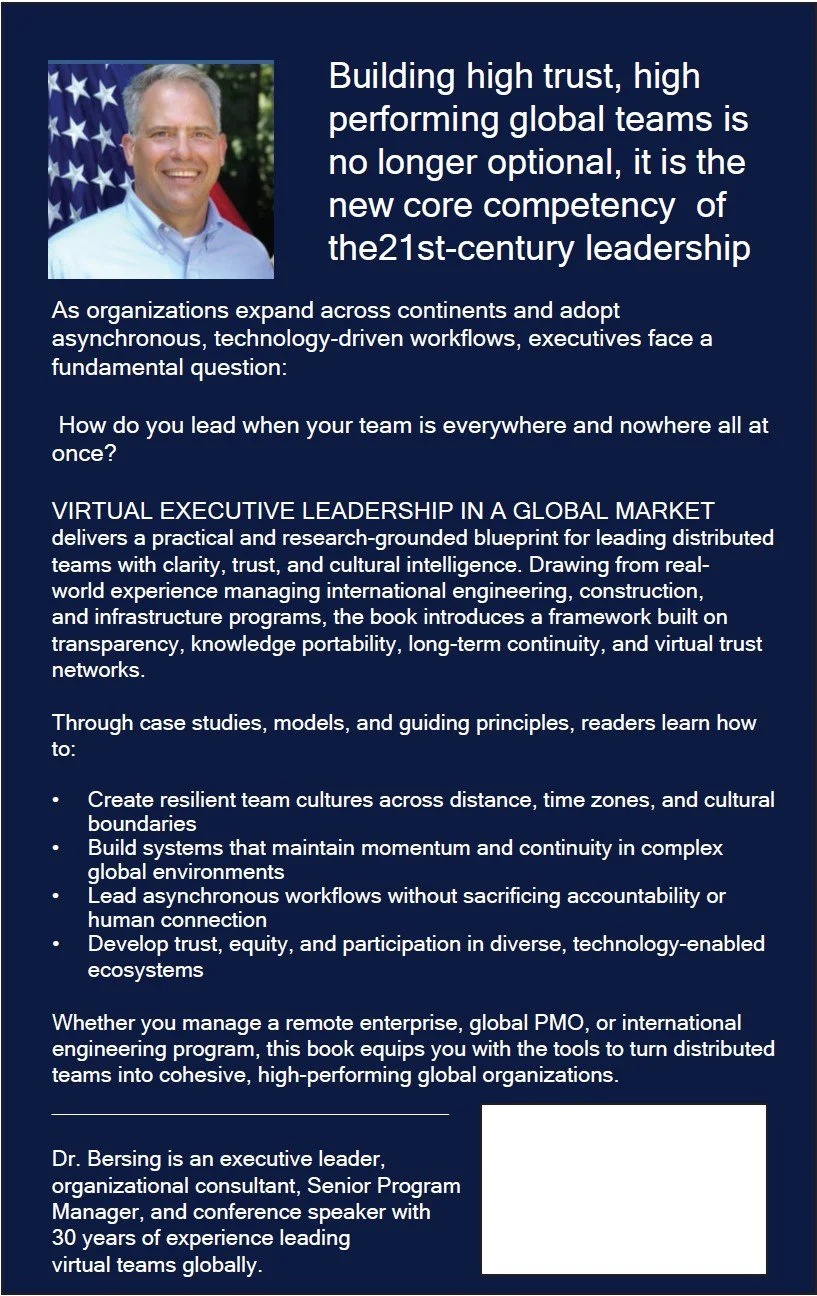
As organizations expand across continents and adopt asynchronous,
technology-driven workflows, executives face a fundamental question:
How do you lead when your team is everywhere and nowhere all at once?
VIRTUAL EXECUTIVE LEADERSHIP IN A GLOBAL MARKET delivers a practical and research-grounded blueprint for leading distributed teams with clarity, trust, and cultural intelligence. Drawing from real-world experience managing international engineering, construction,
and infrastructure programs, the book introduces a framework built on transparency, knowledge portability, long-term continuity, and virtual trust networks.
Through case studies, models, and guiding principles, readers learn how to:
• Create resilient team cultures across distance, time zones, and cultural boundaries
• Build systems that maintain momentum and continuity in complex global environments
• Lead asynchronous workflows without sacrificing accountability or human connection
• Develop trust, equity, and participation in diverse, technology-enabled ecosystems
Author: Bill Bersing, DM, PE, CCM
■
President & Managing Director – iPrograms (IPS Corporation PC)
Visionary Leadership in Program and Construction Management
Dr. Bill Bersing is a global executive and thought leader with more than 30 years of experience managing complex, high-stakes engineering and infrastructure programs across five continents. As President and Managing Director of iPrograms, he leads a collaborative network of engineers, architects, and program management professionals who deliver mission-ready solutions for the U.S. Army Corps of Engineers (USACE), NAVFAC, the Department of State (OBO), and private clients worldwide.
Bill’s early work on Title II programs in Italy, Bahrain, Africa, and the Port of Jebel Ali shaped his hands-on approach to integrating technology, risk management, and data-driven decision-making into every phase of design and construction. His leadership has guided over $4 billion in project portfolios, pioneering modernization and performance accountability in both public and private sectors.
A registered Professional Engineer (VA & MD) and Certified Construction Manager (CCM), Dr. Bersing also holds multiple U.S. patents in digital program management systems, with a focus on predictive scheduling, risk integration, and performance analytics.
Education & Affiliations:
· Doctor of Management (Organizational Leadership), University of Phoenix
· M.S., Management Information Systems, University of Maryland
· B.S., Civil Engineering, Virginia Military Institute
· President, ASCE Virginia Section (2025–26) | Past Governor, ASCE Region 10
· Board of Trustees, Randolph-Macon Academy
Bill continues to drive innovation in program management through applied research, technology integration, and a belief that small, agile teams deliver outsized results when led with integrity and purpose.

Common Questions
-
The main answer is that leading virtually is an entirely different domain compared to leading face-to-face. VEL requires different skills to build trust, maintain long term continuity and to develop high-performance teams. Some of the skills are the same but the difference is apparent to everyone who has led virtually.
-
Trust is built through transparency, consistent follow-through, and communication practices designed for distance, not adapted from in-person habits. The book outlines specific strategies that help leaders create trust networks even when teams rarely meet face-to-face.
-
Virtual teams depend on predictable workflows, knowledge portability, and stable communication rhythms. Without continuity, trust erodes quickly. The book explains how continuity becomes the backbone of long-term virtual success.
-
Virtual settings remove non-verbal cues and increase the chance of misalignment. Leaders must be intentional, structured, and clear in how they communicate. The book provides proven frameworks for doing this well.
-
Cultural expectations shape how people give feedback, handle conflict, respond to authority, and build relationships. Virtual leaders must recognize these differences early. The book introduces a practical model for leading across cultures with emotional intelligence.
-
Yes, but only when leaders actively design systems that create trust, clarity, and shared ownership. High-performance virtual teams don’t happen by accident. The book shows how to intentionally build them.
-
Many try to replicate face-to-face leadership online. Virtual leadership requires different mechanisms for accountability, communication, and connection. The book explains how to avoid this common trap.
-
Engagement grows from purpose, meaningful participation, and clear contribution pathways. Leaders must design ways for everyone to be seen and heard. The book outlines simple practices that elevate engagement in distributed teams.
-
Technology helps—but it doesn’t replace leadership. The real differentiators are trust, continuity, and cultural awareness. The book shows how to integrate tools with good leadership, not substitute them.
-
If your teams are global, hybrid, distributed, or reliant on asynchronous work, you’re already operating in a VEL environment. The book walks you through what readiness looks like and how to strengthen your systems.
[ ADDITIONAL INFORMATION ]